
Afro-textured hair is not ordinary hair. The follicle curls beneath the skin in the shape of a C, and lifting it out whole is a skill of its own, with its own instrument and an eye trained on this pattern. At Sima, Your Hair Center's Istanbul team, with a documented record in patterns 4A, 4B and 4C, works with a curved punch that respects the angle of every root, in a licensed clinic in Aleppo. Send your photos, receive a written plan by graft count before you book a seat, and watch the hair grow back with your own curl, strand by strand.

Ten months on, I looked in the mirror and saw my own hair, my own curl, growing the way it always has. Nobody at Sima needed my hair explained to them. That is what I had been looking for from the start.
Musa · Dubai, United Arab Emirates · 3,800 grafts · pattern 4B
An afro hair transplant by Your Hair Center's Istanbul team, now in Aleppo, with a free consultation in English before you decide.
- A licensed clinic in Aleppo
- Your Hair Center's Istanbul team
- English-speaking coordinator on WhatsApp
- Your curl pattern, kept as it is
Why an afro hair transplant is technically different
An afro-textured follicle grows from a root that curves beneath the skin in the shape of a C, not a straight line. That single anatomical detail changes how the extraction is done, and it is why an afro hair transplant is its own skill. The exit angle, the path of the root under the surface and the depth of the bulb all call for a different instrument, and for an eye trained on this pattern specifically rather than on straight hair. The Istanbul team’s experience with exactly this is documented in numbers in the next section.
A sharp exit angle
The hair leaves the scalp at a steep angle, so the direction the punch enters is entirely different from straight hair.
A root that curves under the skin
Beneath the surface the root turns in the shape of a C. If the instrument does not follow that curve, the follicle is cut before it is out.
Transection, the measure of the skill
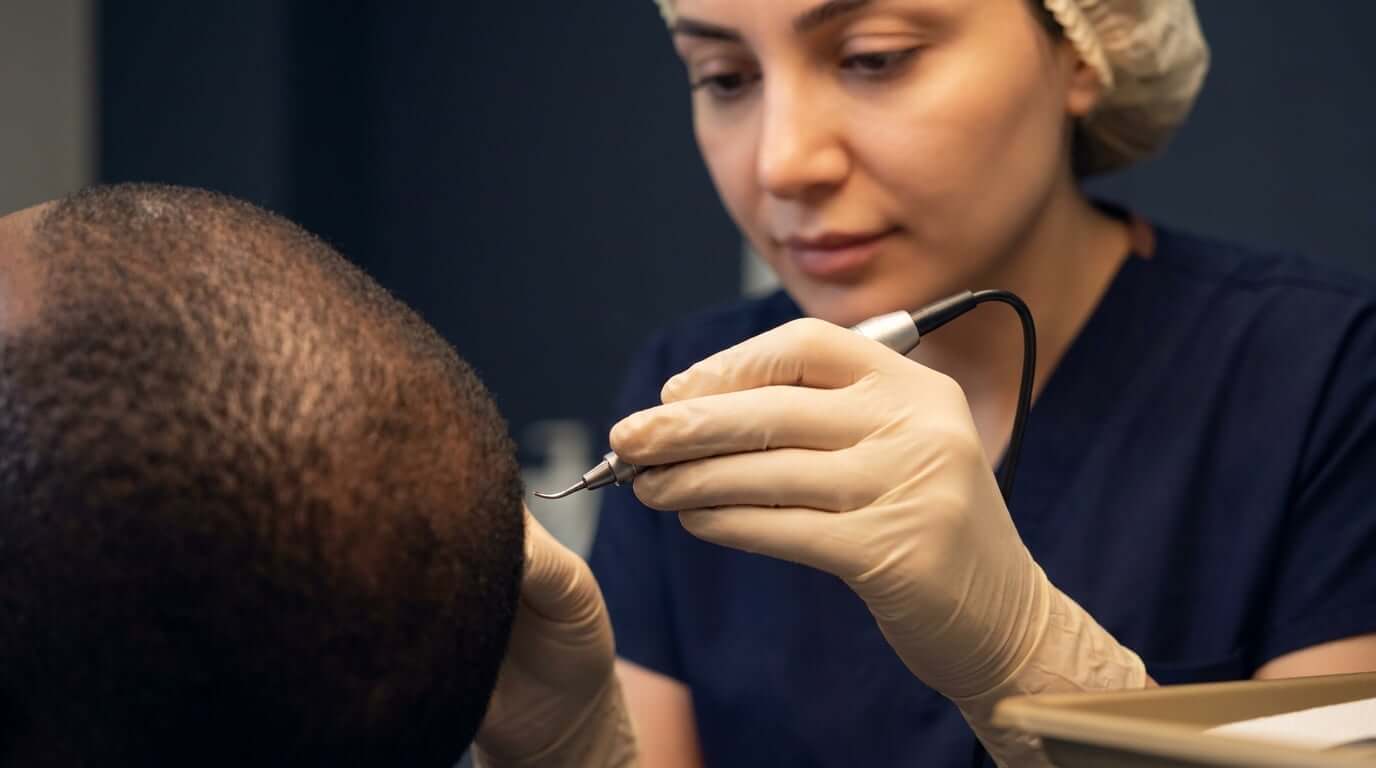
Afro-textured hair calls for a curved punch of a precise diameter, and practice built over thousands of cases, so that as few follicles as possible are cut during extraction.

Istanbul hands with a documented record in afro-textured hair
Your Hair Center’s Istanbul team of FUE specialists, members of the ISHRS and the ESHRS, have given a large part of their practice to afro-textured and curly hair. The same specialists rotate to Sima, a licensed clinic in Aleppo, with continuous supervision from the Istanbul centre.
The team's credentials
- A Turkish team, fully trained in medicine in Istanbul
- Members of the International Society of Hair Restoration Surgery (ISHRS) and the European Society (ESHRS)
- Documented specialisation in FUE for afro-textured hair and in the curved punch
- Operating at Sima, the group’s own licensed clinic in Aleppo
- Continuous supervision, and follow-up in English over WhatsApp until the twelfth month
Aleppo or Istanbul, the whole bill side by side
A fair comparison does not stop at the procedure price. Both of our centres are open to you, so here is the full cost of an afro hair transplant at each one, from the first WhatsApp message to your first day back home.
| Sima · Aleppo | Your Hair Center · Istanbul | |
|---|---|---|
| The procedure | Around ~$1,500 for most cases, at Syrian pricing, by the same team | Around ~$1,800 to ~$3,500 at Istanbul pricing |
| Getting there | Direct flights from Istanbul, Sharjah and Kuwait, and a visa on arrival for most passports | Flights from almost anywhere |
| Nights needed | 4 to 6 nights at Aleppo hotel rates | 4 to 6 nights at Istanbul hotel rates |
| Food and getting around | Aleppo prices, with airport pickup arranged by Sima | Istanbul prices |
| Working days away | About a week, travel included | About a week, travel included |
| Payment | Cash in US dollars or euros, with cards accepted in a growing number of places since 2026 | Card or cash |
| Follow-up after you fly home | Monthly over WhatsApp for 12 months, in English | Monthly over WhatsApp for 12 months, in English |
| The whole bill, door to door | Around ~$1,500 plus travel at Aleppo prices | Around ~$2,570 to ~$4,800 once flights, hotel and lost days are counted |
The figures are a guide. Your figure is confirmed in writing after the consultation, by graft count and donor area. Travel, hotel and airport pickup are arranged by Sima and billed separately at cost. Most Western governments advise against travel to Syria; their advice is linked on the travel guide.
Are you a candidate, by curl pattern
We do not answer yes or no before the consultation. Here is what the team actually assesses before an afro hair transplant, pattern by pattern, so that you know what happens in the examination room.
Pattern 4A, medium curl
Extraction skill required ●●○○
- Enough density in the donor area, the back and the sides
- An exit angle that can be read clearly during extraction
- A healthy scalp with no chronic inflammation
- Age over 22, with a reasonably stable pattern of loss
Pattern 4B, strong angular curl
Extraction skill required ●●●○
- A specialised curved punch that follows the angle of the root
- Slow, precise extraction that keeps the follicle whole
- A session paced over enough hours, without fatigue
- A plan that keeps the original curl pattern along the hairline
Pattern 4C, dense helical curl
Extraction skill required ●●●●
- A sharply curved root that calls for specific experience
- A longer session protocol, or a split across two sessions
- Realistic expectations from the first consultation
- Confidence that the curl is kept as it is, never straightened
A note on keloid scarring
From WhatsApp to month twelve
What actually happens, step by step, in English, with the same team following you from the first message to the full year. Travel notes, including your own government’s advice, are on the Aleppo travel guide.
A WhatsApp message
A message in English, and a reply within an hour on working days. The team asks for a few photos for a first assessment, with no obligation.
Consultation and a written plan
Curl pattern, donor density and the expected result in numbers. A written plan reaches you on WhatsApp before you book a seat.
Procedure day in Aleppo
A session of 7 to 9 hours with a curved punch, in a room where English is spoken. Back at your hotel by evening.
Recovery, here and then at home
Daily check-ins on WhatsApp through the first week, then weekly through the first month, wherever you are. The crusts clear gradually.
The full result
Full density comes in between the sixth and the twelfth month. Photographic documentation of how the curl grows in, with your consent.
Questions we hear
Questions from every consultation, in two columns of equal weight. The first covers your stay, your recovery and the arrangements. The second covers your hair, your skin and two questions of faith.
Your stay, recovery and arrangements
How many days do I stay in Aleppo after the procedure?
For an afro hair transplant, plan four to six nights. The team usually asks for 3 to 5 days after the session, for direct follow-up and a first wash under medical supervision. After that you can fly, and the follow-up continues on WhatsApp.
Can I fly home within a week?
Yes, in most cases. We suggest an aisle or window seat with nothing pressing on the head, and no heavy bag on the shoulder for the first two weeks. Most Western governments advise against travel to Syria; their advice is linked on the travel guide, with what operates on the ground and the dates.
Can I fold the procedure into a longer trip?
Yes. Many visitors add two or three nights for the citadel and the souq, and the team times the session so that recovery begins before the rest of the trip. From June to August the calendar is planned around travellers from the Gulf, so tell us early which dates you hold. If you are Syrian and coming home, time the procedure with the visit; the team stays with you over WhatsApp after you fly back.
How does the follow-up work once I am home?
After an afro hair transplant the follow-up runs the same twelve months as every Sima case. Daily photo check-ins on WhatsApp for the first week, weekly through the first month, then at the milestones of one, three, six and twelve months. All of it in English.
What do I bring on procedure day?
A shirt that buttons at the front, so nothing is pulled over the head, a loose hat and comfortable clothes. The team gives you the complete aftercare kit.
Your hair, your skin and your faith
Is a hair transplant permissible in Islam?
In the view of most contemporary scholars, a hair transplant restores what is natural to the body. It is not the prohibited hair extension, and it does not fall under the forbidden sense of changing God’s creation. For a particular case, ask a scholar you trust.
When can I pray and perform wudu after the procedure?
Prayer continues from the first day. Prostration is done gently on the forehead for the first five days, and some prefer a soft mat. Wudu is as usual, without rubbing the scalp directly during the first week.
Will the curl keep its original pattern once the hair grows?
Yes. A transplanted follicle keeps its genetic pattern, so the new hair carries the same degree of curl as your follicles in the donor area. No straightening, no change of pattern. It is the point we confirm to everyone who asks about an afro hair transplant.
My family has a tendency to keloids. Am I a candidate?
We ask about family history at the consultation. Where the tendency exists, we use a small test patch and adapt the extraction protocol. We take the case only once the history and the test patch have given a clear answer.
Will I need more than one session?
It depends on the number of grafts required, the donor density and the degree of curl. Dense 4C patterns may need two sessions, 8 to 10 months apart. The plan is set out in the written consultation.
Write to us on WhatsApp, and someone who understands your hair replies
Your message goes to the team that studies your case and performs the procedure, through an English-speaking coordinator who stays with you at the clinic. No agency in between, and no ambiguity.
