
A hair transplant for women at Sima begins with a photo assessment you receive in writing, in English, from the same Istanbul specialists of Your Hair Center. No templates. A personal plan in your name sets out the graft count, the proposed hairline and what to expect month by month until the twelfth month. The no-shave option is there when the pattern of loss allows it, a female team is with you at the sensitive stages, and nobody at the hotel or the airport needs to know why you came. A written figure before you book a seat.

Between the confidence you carry and what the mirror shows, a quiet distance
There is a distance only you know about. Confidence on the inside, and a reflection that does not quite match it. Before we talk about a hair transplant for women, or about any procedure at all, we want to stop at that distance. What you are looking for is not something new. It is a feature that was always yours, thinned a little by time. Sima listens first. Every step after that starts from your case, not from a plan written in advance.

Patterns of hair loss in women
Before there is a solution, there is a diagnosis. Hair loss in women does not take one shape, and each pattern has its own cause, its own course and its own outlook. Know your pattern first, then decide what suits you.
Frontal thinning
Thinning that starts at the hairline, gradually exposing the forehead and changing the frame of the face. The pattern women ask about most, and the one a frontal transplant addresses with precision.
Diffuse thinning
A gradual loss of density across the whole scalp, graded on the Ludwig scale. Common in mid-life, and it responds to careful plans that combine densification with supportive treatment.
After childbirth
Usually temporary. It begins a few months after the birth and recovers within a year. We do not propose a transplant for shedding after childbirth; if it lasts beyond a year, we look for the real cause and treat it.
Hormonal and hereditary
A hereditary predisposition, or a hormonal disorder such as polycystic ovaries or a thyroid imbalance. It needs a medical diagnosis, and the answer may be a treatment before it is a transplant.
We bring back what was yours. We do not change you
Sima does not set out to repair anyone. It brings back into the light a woman who was always there. The difference between repairing and revealing is not a matter of words. It is a matter of intent. We do not add a feature that is foreign to you. We restore one that was always yours and that time had partly hidden. Every step that follows starts from that rule.
No booking prompt here. This is a pause for thought.
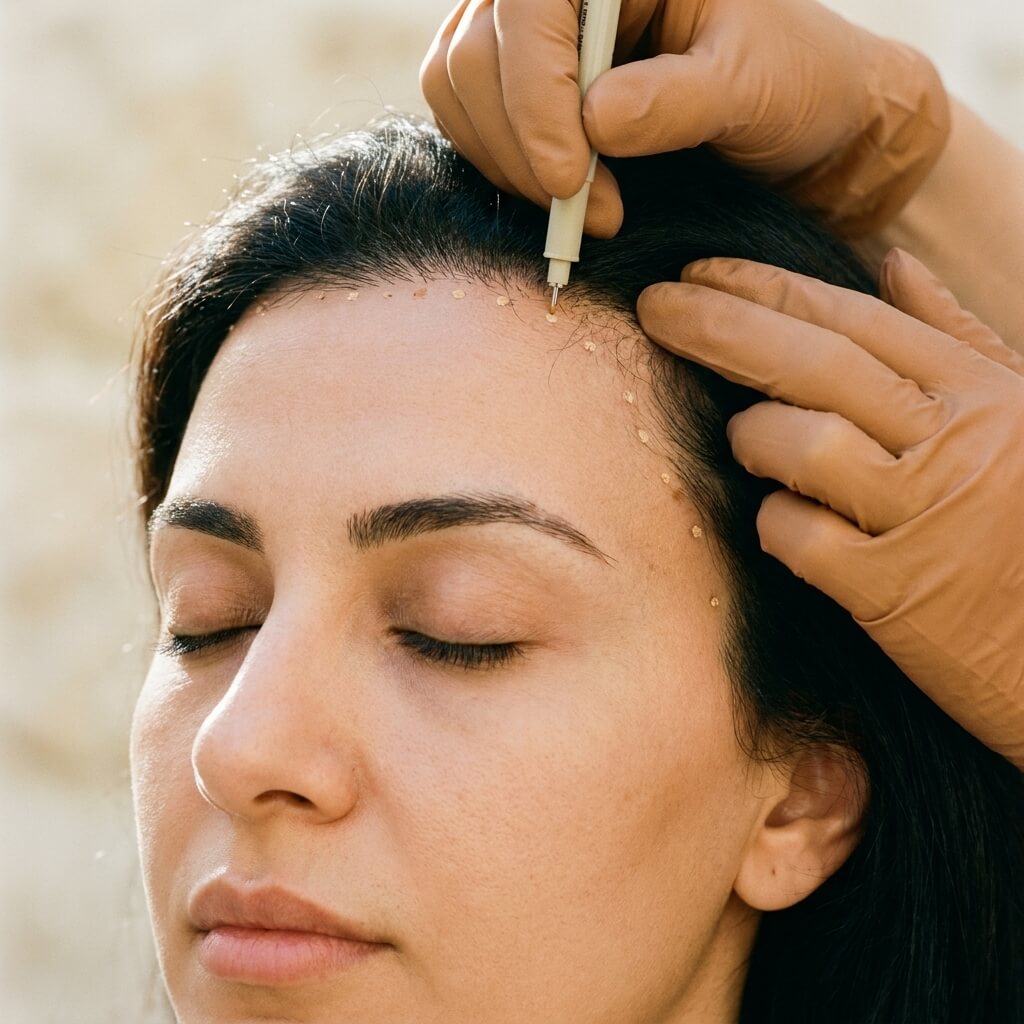
Frontal hair transplant for women
The hairline is the frame of the face, and in most cases it is the first place a change is noticed. For a woman, a forehead that feels wider, or a small gap at the centre parting, is not a technical matter. It is a daily one. Your Hair Center’s Istanbul team works on this line with measured points, drawing density before drawing shape, and keeping the natural angle of the follicle at every point.
- A shape that fits the features of your face, not a template.
- Angle and density matched to the texture of your own hair.
- Full personalisation in the design session before the procedure.
We plant density. We do not promise miracles
A transplant without shaving. Dignity before technique
Long hair, as you came
No full shave, no change to how you usually look. You arrive at the clinic with your hair, and you leave with the same hair.
A limited area only
The front is never shaved. At the back, either a narrow strip a few millimetres wide is shaved and hidden under the longer hair above it, or selected hairs are trimmed one by one. A female team is with you at the sensitive stages.
Hard for anyone to notice
You go back to your work and your family, usually within 2 to 3 days, with the treated area under your own hair. What happens between you and Sima stays that way.
We offer the no-shave option in cases where the extent of the loss and the strength of the donor area allow it. It allows up to about 1,500 grafts in one session; larger cases are planned with shaving or over two sessions. We do not promise it in every case, and we do not sacrifice the result for it. When it suits your case, it is fully yours.
Your Hair Center's specialists. A record you can check
The team that performs your procedure at Sima is the same team that has worked for years in our Istanbul centre, Your Hair Center, and it operates in Aleppo under a valid local medical licence. What once meant a trip to Türkiye now takes place in a licensed clinic in Aleppo, and you can check the Istanbul centre at yourhaircenter.com before you decide.
Years of experience
In Istanbul’s leading FUE hair transplant centres.
Cases led
Cases in which the Istanbul team led the planning and the procedure, women’s and men’s.
Local licence
A licensed clinic in Aleppo, operating under a valid Syrian medical licence.
Sterilisation protocol
Equipment and sterilisation standards matching those used in Türkiye’s reference clinics.
I had researched the Istanbul team for months. Aleppo gave me the same specialists, a quieter week, and nobody at work knew I had been away for anything but a holiday.
Assessing candidacy. A calm list, no pressure
Sima assesses before it sells. If a transplant is not the right answer for your case, we say so clearly and point you to the option that is.
- A stable pattern of loss, Ludwig 1 to 3
- A donor area with enough density at the back of the head
- Usually aged 25 or over once the loss is stable, never under 20
- Hormonal stability confirmed by recent tests
- Not currently pregnant or breastfeeding
- Good general health with no active autoimmune condition
- Realistic expectations of the result
Some patterns of loss recover with supportive treatment and no transplant at all. We point you honestly to what suits your case.
Hair loss treatment
PRP and mesotherapy
The FUE technique. Simply, without excess medical detail
A short, plain account of what happens on the day of the session. The full explanation of the technique is in the complete guide to hair transplants.
Extracting the follicles
A precise transfer of follicles from the donor area at the back of the head, using fine FUE instruments. No surgical incisions, no stitches.
Opening the channels
Microscopic openings in the recipient area, at angles that follow the natural direction of your hair. This stage decides 70% of how natural the final result looks.
Implanting
The follicles are placed one by one, at the right density for each point. The session usually takes 6 to 7 hours, depending on the number.
The price, against the full cost of the Istanbul trip
The package at Sima, against what the same procedure costs once you fly to Istanbul, line by line. Both centres are ours, so the comparison is an honest one.
At Sima, Aleppo
Your Hair Center, Istanbul, the full cost
Most Western governments advise against travel to Syria; their advice is linked on the travel guide.
Travel, hotel and airport pickup are arranged by Sima and billed separately at cost
What Istanbul cannot give you. A quieter week
The part that never appears on a price quote is where you wake up the morning after the session, and who is around you. In Aleppo that is a quiet hotel a few minutes from the clinic, a coordinator who speaks your language, and a city that moves at a slower pace than Istanbul. Syria received 3.52 million visitors in the first half of 2026, Aleppo’s airport runs scheduled flights, and the citadel and much of the covered souq have reopened. Nobody at the hotel or the airport needs to know why you came. If you are Syrian and coming home, time the procedure with the visit; the team stays with you over WhatsApp after you fly back.
- A hotel near the clinic, arranged by Sima and billed at cost
- An English-speaking coordinator with you from the airport to the first wash
- Daily WhatsApp check-ins in the first week, wherever you are
- A schedule planned around your flights and your privacy
- Monthly follow-up over WhatsApp for twelve months after you fly home
Most Western governments advise against travel to Syria; their advice is linked on the travel guide.
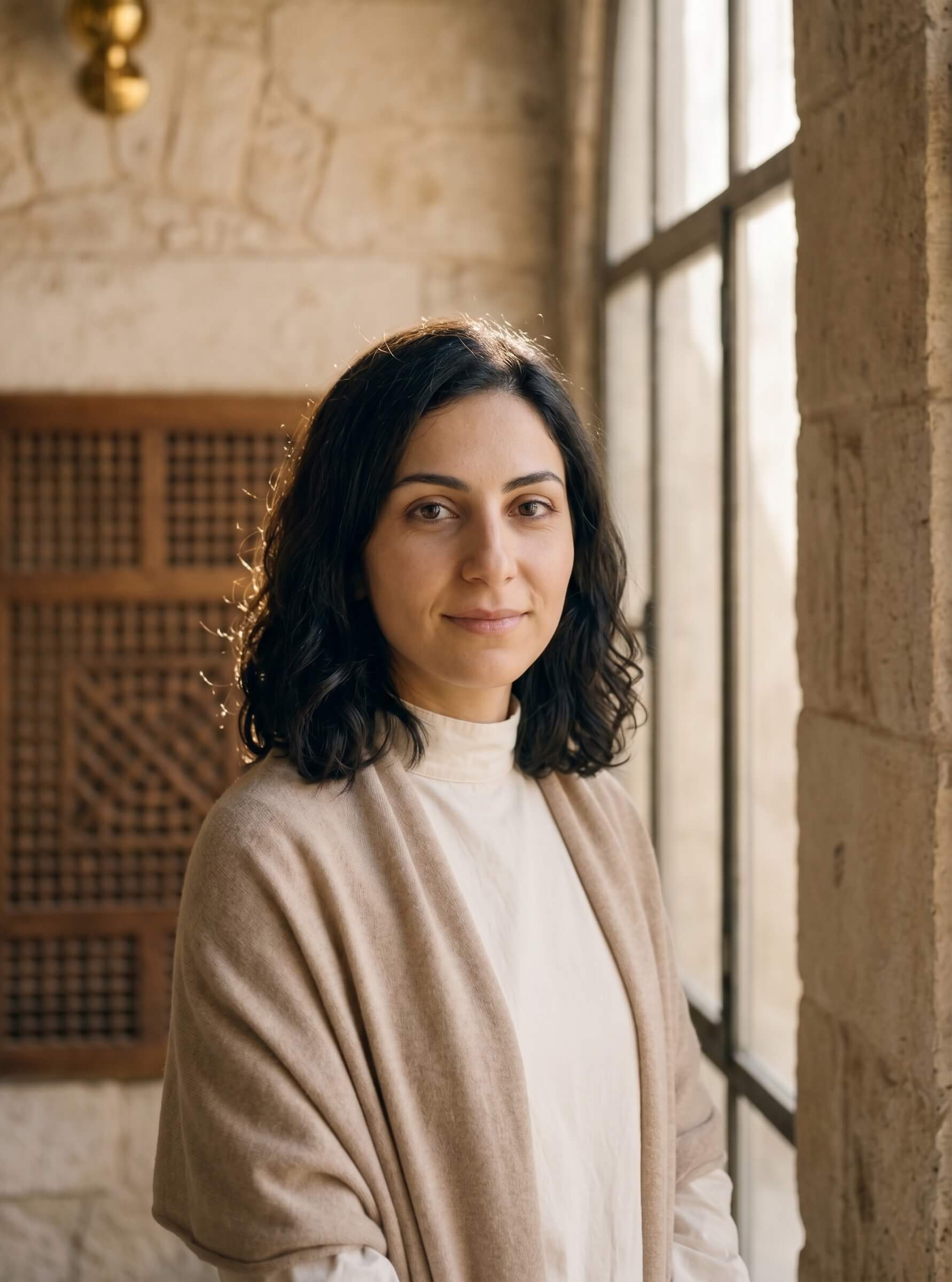
Aftercare for women
Details most other pages leave out, because they concern your actual daily life rather than the technique. Headscarves, prayer, sleep and the shedding phase.
When can I wear a headscarf or a hat again?
In the first week, nothing tight should touch the implanted follicles, and the clinic gives you a soft medical band for the first days. From about day seven to ten, a loose, light headscarf is possible, as long as it does not press on the recipient area. After about 14 days, you can wear your usual firmly wrapped hijab. Men can wear a loose cap from about day ten, and tight hats or helmets after 3 to 4 weeks. This is an approximate schedule, and it is tailored in the follow-up plan written for you.
Prayer and ablution in the first days
For the first 5 days, pray seated or make prostration with a gesture so that the forehead and hairline do not press on the ground; scholars permit this for a medical excuse. From day 6 until the crusts fall, make a light prostration on the nose and lower forehead with the grafted hairline kept off the ground; if your hairline was lowered, stay with the gesture until the doctor allows. Full prostration returns once the crusts fall, on the day the doctor confirms. For ablution, keep water off the grafts for the first 2 to 3 days and wipe the rest, and if wiping itself would harm the grafts, scholars allow tayammum for the head instead. From day 3, pass a wet hand gently over the head without rubbing, and return to normal ablution once the crusts fall, around day 10 to 14. Ask a scholar you trust for a personal opinion.
Shock loss, the whole truth
Between the second week and the third month, what is known as shock loss, or telogen effluvium, takes place. The implanted follicles enter a temporary resting phase, and the visible hairs may shed. This is expected, and it does not mean the procedure has failed. Real growth begins after the third month, the first result shows at the sixth month, and the final result arrives between the twelfth and the eighteenth month. In women this phase is sometimes more noticeable, which is why we tell you about it before the procedure, not after.
Sleeping position in the first days
After a hair transplant for women the sleeping position matters for the first three nights. Sleep on your back, raised at about 45 degrees, for the first seven to ten days, so the recipient area does not rub against the pillow. A purpose-made pillow is given to you in the aftercare kit at the first visit.
Hair transplant for women, the questions we are actually asked
A list of the questions that actually reach us over WhatsApp. The answers are calm, and they neither play down nor inflate.
Can I have the procedure without anyone knowing?
Yes. A hair transplant for women at Sima is planned around privacy from the first message. Yes, when the pattern of loss suits the no-shave option. The donor area is worked within a small window that disappears under your existing hair. Your appointments are planned around your case, and what happens between you and Sima stays that way unless you choose to share it.
Is the procedure low-risk, and what are the possible complications?
FUE is among the lowest-risk medical aesthetic procedures when it is carried out under specialist supervision in a sterile setting. The complications that can occur include temporary redness, mild swelling or itching in the recovery week. The shock loss phase is a normal part of the course, not a complication. All of it is explained to you in writing in the plan before the procedure.
What is the success rate of a hair transplant for women?
The international survival rate for implanted follicles in FUE is between 90% and 95% under specific conditions. A healthy donor area, hormonal stability, and a recovery plan followed closely. We do not quote a separate rate for women out of context, because the number alone does not give an accurate picture of your case.
How many grafts will I need, and how much does it cost?
The number depends on the pattern of loss and its extent. Hairline cases usually fall between 1,200 and 2,500 grafts, and diffuse densification may need more. A typical FUE case at Sima comes to around $1,200, against roughly ~$2,570 to ~$4,800 for the equivalent trip to Istanbul once flights, hotel and lost working days are counted. Your figure is confirmed in writing after the consultation, by graft count and donor area. Travel, hotel and airport pickup are arranged by Sima and billed separately at cost.
Are there long-term harms for women?
There are no documented scientific studies linking a hair transplant to long-term harm. The procedure is superficial and confined to the upper layer of the scalp. Shock loss is a temporary phase, not a harm. Cosmetic harm, an unnatural look or an artificially high hairline, usually comes from poor design rather than from the technique itself, which is why the design session with an experienced specialist is the factor that matters most.
Is a hair transplant permissible in Islam?
Most contemporary scholars permit a hair transplant for a woman when the aim is to treat loss with a medical cause, such as polycystic ovaries, hereditary alopecia or burns. A transplant moves the woman’s own follicles from one area to another, which is different from extensions that add hair from outside the body, and it is the latter that the prohibition addresses. Scholars draw that distinction clearly. For individual cases, ask a scholar you trust.
How many nights do I need in Aleppo, and how do I get there?
Four nights covers the pre-operative check, the procedure day, the first wash at the clinic and a day of rest, and with the no-shave option you fly home looking as you arrived. Direct flights run from Istanbul, Sharjah and Kuwait, and most passports receive a visa on arrival paid in cash. Most Western governments advise against travel to Syria; their advice is linked on the travel guide. Read the guide before you book a seat.
A calm consultation, no obligation
A written conversation, not a pressured call. You send the photos, and the assessment and the plan come back to you. The decision is yours, whenever you choose.
